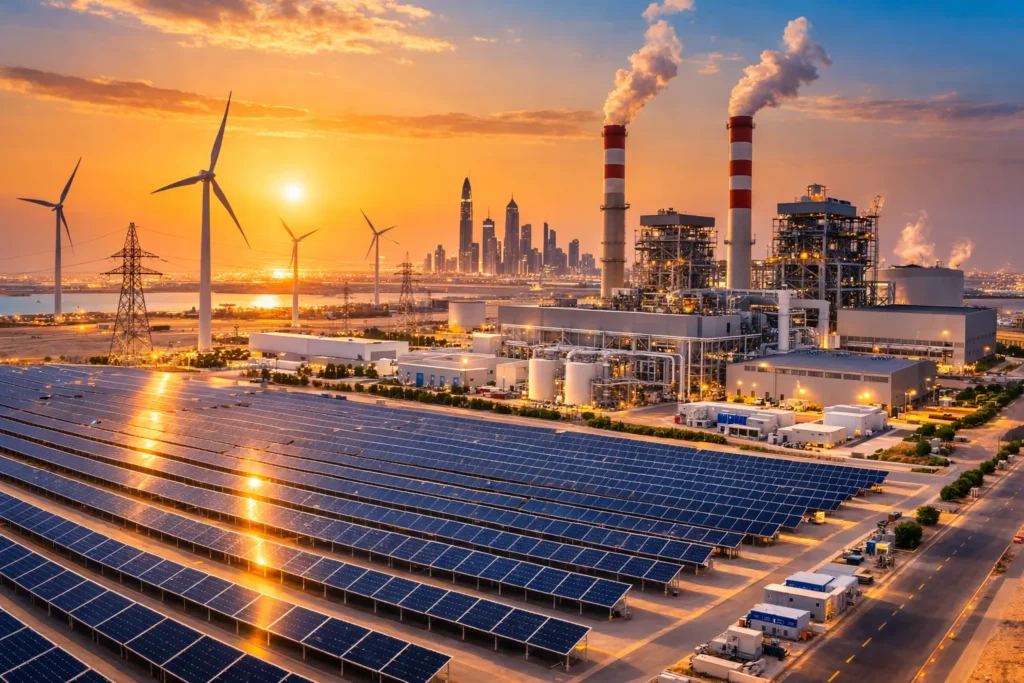


Across the Middle East, industrial solar power plants are becoming a core component of energy strategy for factories and large industrial facilities. High solar irradiation, declining technology costs, and rising electricity demand make solar energy for factories a financially attractive and operationally reliable solution. When delivered by experienced solar EPC companies in the UAE, industrial solar projects can also scale toward utility-scale solar in the Middle East, creating long-term value for asset owners.
Why the Middle East Is Ideal for Industrial Solar Power
The region offers a rare combination of conditions that strongly favor industrial solar deployment:
- Exceptional solar resources with high capacity factors
- Large industrial zones with available rooftop and land space
- High daytime energy consumption aligned with solar generation
- Increasing pressure to reduce energy costs and emissions
For energy-intensive industries, these factors turn solar from an environmental initiative into a cost and risk management tool.
What Is an Industrial Solar Power Plant?
An industrial solar power plant is a solar PV system designed to supply electricity directly to industrial loads, either fully or partially. These systems may be:
- Rooftop solar plants on factories, warehouses, and logistics hubs
- Ground-mounted systems within industrial zones
- Large on-site plants approaching utility-scale capacity
Depending on the design, systems can operate grid-connected, hybrid, or integrated with storage.
Solar Energy for Factories: Key Use Cases
1. Direct Load Offset
Solar generation directly supplies production lines, reducing grid consumption during peak operating hours.
Result
- Lower electricity bills
- Predictable energy costs
- Reduced exposure to tariff increases
2. Industrial Expansion & New Facilities
Solar can be integrated at the design stage of new factories, lowering long-term operating expenses from day one.
3. Hybrid & Utility-Scale Integration
Large industrial players increasingly deploy solar at a scale that borders utility scale solar in the Middle East, especially in cement, steel, chemicals, and manufacturing clusters.
System Design Options for Industrial Solar
Rooftop Industrial Solar
- Fast deployment
- No additional land requirements
- Ideal for warehouses and manufacturing plants
Ground-Mounted & Captive Plants
- Higher capacity potential
- Easier maintenance access
- Suitable for heavy industry and industrial parks
Solar + Storage (Optional)
- Peak demand support
- Improved energy reliability
- Better utilization of generated solar power
The Role of Solar EPC in the UAE
Industrial solar success depends heavily on the EPC partner. A capable solar EPC UAE provider delivers:
- Accurate energy yield modeling
- Industrial-grade engineering and safety compliance
- Procurement of high-quality modules and inverters
- Turnkey construction and commissioning
- Long-term O&M and performance guarantees
This is where experienced players make a measurable difference.
Cost, ROI, and Long-Term Value
For most industrial users in the Middle East, solar economics are compelling:
- Payback periods: typically 3–6 years
- System lifespan: 20–25 years
- Post-payback energy: near-zero marginal cost
Beyond direct savings, solar improves asset value, ESG performance, and energy security.
Industrial Solar vs. Utility-Scale Solar
While industrial solar plants serve on-site demand, the line between industrial and utility-scale projects is increasingly blurred.
Industrial focus
- Captive consumption
- Cost optimization
- Operational resilience
Utility-scale focus
- Grid export
- Long-term PPAs
- Infrastructure-grade investment returns
Many large industrial players now pursue hybrid models that combine both.
Strategic Importance of EPC & Development Partners
Delivering large industrial solar projects requires deep technical expertise, regional execution experience, and financial discipline. Collaboration with specialized developers and EPC groups ensures projects are delivered on time, on budget, and at expected performance levels.
Partnerships involving organizations such as Arni Energy demonstrate how integrated development and EPC capabilities can translate solar potential into reliable industrial energy assets.
The Future of Industrial Solar in the Middle East
Looking ahead, industrial solar adoption will accelerate due to:
- Continued decline in PV and inverter costs
- Integration with battery storage and AI-based energy management
- Tighter emissions and sustainability requirements
- Expansion of large-scale industrial zones
Solar power plants are becoming standard infrastructure for competitive industrial operations.
Solar power plants for industrial use in the Middle East offer a powerful combination of cost reduction, energy security, and sustainability. Whether deployed as rooftop systems or large captive plants, industrial solar is reshaping how factories manage power.
With the right EPC partner and scalable design approach, industrial solar projects can evolve into long-term energy assets—supporting both operational performance and regional energy transition goals.